Courtesy of the Swedesboro Woolwich Historical Society, we will be featuring articles on historic people and events in this area. If you are new to this area or have been here all your life, I hope you find these are interesting and informative stories.
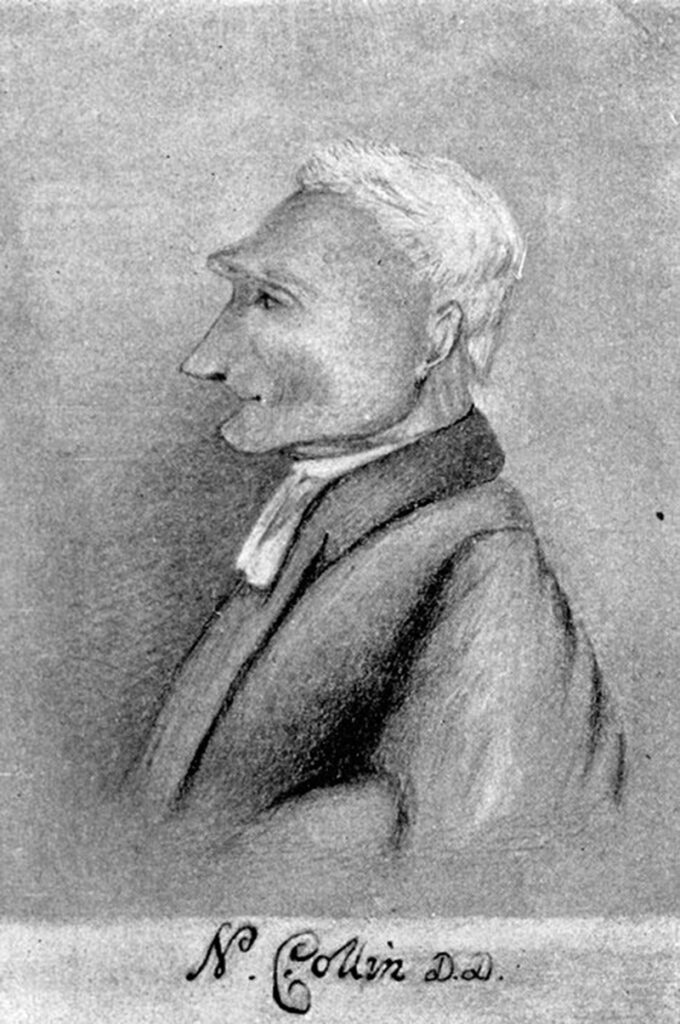
The Rev. Nicholas Collin was the last Swedish rector of the Swedish Lutheran Church in Swedesboro. He had dreamt of becoming a missionary to America while still a seminary student in Sweden, despite reports of the wild and dangerous nature of the country.
Soon after being ordained at the University of Uppsala in 1768, the Consistory of Uppsala recommended Collin as an assistant pastor to the Swedish mission on the Delaware. Accordingly, he set off from Stockholm for America arriving in Philadelphia on May 12, 1770.
After a brief stay in Pennsylvania, Collin crossed the Delaware into New Jersey, debarking at the little village of Swedesboro (formerly Raccoon) on May 19. Collin was a much welcome guest at the home of Jonathan Wicksell, the senior pastor of the Swedish Lutheran Church.
In October 1773, Collin was appointed the senior rector for the Swedesboro and Penn’s Neck (Pennsville) churches just as the clouds of war were gathering ominously on the horizon. He had served as assistant pastor under the tutelage of Rev. Wicksell, who was now returning to Sweden.
Throughout the looming conflict, Rev. Collin would try to remain neutral, often at the peril of his life, as he continued to minister to the congregations of both parishes.
When the Revolutionary War finally arrived in West Jersey, it was fought not as a conventional war between armies, but rather as a bitter civil war that often pitted neighbors against neighbors. In Swedesboro and Woolwich, Collin observed that only one soldier fell in battle “because both parties fought not like real men with sword and gun, but like robbers and incendiaries.”
On Feb. 4, 1777, Collin was arrested by local patriot militiamen on suspicion of being a loyalist and for allegedly spying upon his neighbors. Collin claimed that the charges were trumped up by “a man of rather bad character.”
The pastor was given 15 minutes to prepare for a march of over 100 miles. Collin wrote, “They also wanted me to cover the distance by foot, which I refused.”
Granted permission to ride, Collin noticed that some of the militiamen were drunk, randomly firing their muskets into the air for their own amusement. As darkness approached, Collin feared for his life. “Their wish was, as I later discovered, that I should attempt to escape, for then they would have a better excuse for such a low deed [i.e., shooting him], but for this I was too wise.”
Fortunately, after traveling about six miles, Dr. Bodo Otto, Jr., a colonel of militia, made a timely appearance and secured Rev. Collin’s release by paying his bail. The next day, the authorities gave Collin the option of going over to the British or signing an oath of loyalty to the new patriot government.
He refused. Collin wrote in his journal, “I could not give my oath of allegiance to any but my own [Swedish] government [and] I could not, like other American clergymen in the place urge the people to revolt.”
Consequently, the patriots allowed Collin to sign a pledge promising that he would remain neutral, and do nothing unworthy of a Swedish citizen, and that he be permitted to leave the country unhindered if necessary. A disgusted Collin wrote, “Among a more civilized and generous people this adventure could never have happened to me.”
In the winter of 1778, General “Mad Anthony” Wayne spent the night as a guest of the Rev. Collin at the parish house in Swedesboro. The general and his men were on a mission to drive cattle, commandeered from South Jersey farms to the Continental Army cantonment at Valley Forge.
Reverend Collin described General “Vain” as a “well-bred gentleman.” He also noted the condition of Wayne’s 300 men “… of whom the greater part were miserably clothed, some without boots, others without socks.”
The British arrived in Swedesboro the next day looking for Wayne and his cattle drovers, but the Americans were already gone. “I dressed in haste and stepped out, and showed the Commander my commission and requested not to be molested in any way.”
The British colonel “answered politely” and agreed to post guards at all the larger houses in town and at the rectory to ensure the safety of the citizens. But later when Collin approached the gate of his own house, a British sentry almost shot him for failing to identify himself.
Later in the war, American militiamen used Collin’s church as a barracks, filling the place with “filth and vermin.” The congregation was deprived of the use of the church for divine services. Collin wrote, “I therefore had to preach in private houses.”
After the war, the old log church was in such a dilapidated condition, Collin began soliciting funds to build a new house of worship. In 1784, a foundation was laid for the new Swedesboro church with Reverend Collin inspecting every brick.
The edifice was completed in 1786 and still functions today as the Trinity “Old Swedes” Episcopal Church thanks to the tireless efforts of the Reverend Nicholas Collin.
By Bennett Carlton