
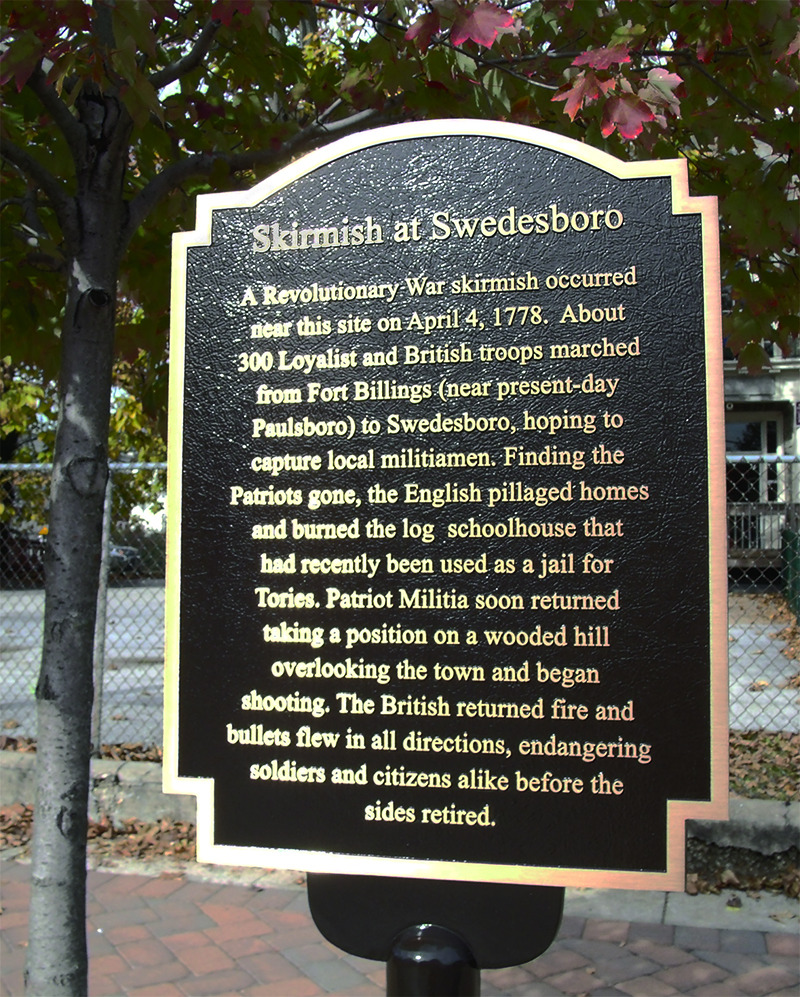
Near the end of March 1778 the Reverend Nicholas Collin, rector at the Swedish Lutheran church at Swedesboro, noted in his journal that 15 people had been arrested for trading with the British. Some of the perpetrators belonged to his congregation.
They had been jailed in the schoolhouse overnight and marched off “under guard into the country” the following day. The guards were under strict orders to shoot the prisoners should they encounter any British patrols on their way to the courthouse.
Consequently, in the early morning hours of April 4, a company of British light infantry troops were ferried over the Delaware to the British-held Fort Billingsport (present-day Paulsboro). There they joined with part of the Loyalist garrison and proceeded to march to Swedesboro, hoping to capture the militiamen quartering there and to facilitate the escape of any Tories who wished to go over to the British in Philadelphia.
The only detailed source historians have for the ensuing skirmish was the eyewitness account written by Reverend Collin. The clergyman wrote that “300 refugees [i.e., Loyalists] and English troops arrived in three divisions to surround the militia, which escaped with great difficulty.”
At daybreak the combined British and Loyalist force marched into town as the Americans, apparently taken by surprise, hastily retreated. The militia belonged to Captain Cornelius Nieukirk’s Company from Pittsgrove Township; Captain Jonathan Beesley’s men from Cumberland County; Captain Ward Pierce’s Company; and the local militiamen commanded by Captain Robert Brown of Swedesboro.
Ironically, many of the Loyalists opposing the militia were the erstwhile friends and neighbors of the citizens of Swedesboro. In fact, a captain of the raiding provincials was one John Cox of Woolwich, who had taken part in many previous expeditions against the Patriots. Cox owned a plantation in Woolwich but had previously been taken prisoner by local authorities.
Cox managed to escape his captors and joined the provincial unit then being organized by the British. He was appointed captain in what became known as the West Jersey Volunteers.
After the war, Cox and many of his Loyalist friends would be indicted for treason by the Inquisition for participating in raids against their Patriot neighbors and for “taking the good subjects prisoners and destroy[ing] their property.”
In the meantime, after the militia withdrew from town, the British proceeded to plunder a few houses and set fire to the aforementioned schoolhouse. The one-room school was constructed of cedar logs and went up like a tinderbox.
Reverend Collin wrote that the Loyalists “burnt down the schoolhouse for the simple reason that their friends had been kept prisoners there.” Collin scolded the British for their “un-Christian and wicked behavior,” which was the “worst disservice they could do [for] their King.” Collin wrote, “The officers agreed with this, but said they were unable to keep proper military discipline.”
As the schoolhouse burned, the Americans regrouped on a nearby wooded hillside and began firing into the town. The British returned fire and musket balls filled the air.
Collin wrote, “I and some others went out to look on, but both parties aimed so badly, that the bullets flew in all directions, so that it was best to stay inside.”
The indiscriminate firing eventually died down with neither side having gained an advantage. Despite all the shooting there were no casualties.
With ammunition running low, the British/Loyalist force soon marched back to Fort Billingsport unimpeded, leaving the schoolhouse a smoldering ruin.
This wasn’t the first British-led raid on the village, formerly known as Raccoon. On March 27, 1778, 60 Loyalists from the fort, backed up by a contingent of Royal Marines, had raided Swedesboro, capturing a Continental officer and two recruits for Washington’s army at the tavern on Kings Highway. The British also paused on this occasion to ransack a few houses in Swedesboro before departing, allegedly skewering a litter of kittens in one home on the points of their bayonets.
In the aftermath of the incendiary raid on April 4, Collin recorded a further tragedy that occurred a short time later. Early in the morning on Easter Sunday (of all days), the Reverend was awakened by loud, piercing cries.
He wrote, “When I came out I saw a terrible sight. A man… was tied to a pine tree and was being whipped. He fainted at times, but when he recovered, the flogging continued.”
Collin does not identify the unfortunate victim but wrote that his crime was simply profiting from trading with the British. The man died from his injuries a few days later.
Perhaps the severe punishment was inflicted upon him, in part, as a response to the raid on April 4.
One reason for the numerous raids and skirmishes in and around Swedesboro was that the garrison at Fort Billingsport was not regularly supplied with provisions from the British then occupying Philadelphia. The Loyalist troops were expected to forage the countryside to supplement their rations.
Many of the provincials seized upon the opportunity to extract vengeance with reprisal raids against their former neighbors. It was a time for settling old scores in Swedesboro and Woolwich.
By Bennett Carlton, Swedesboro-Woolwich Historical Society