
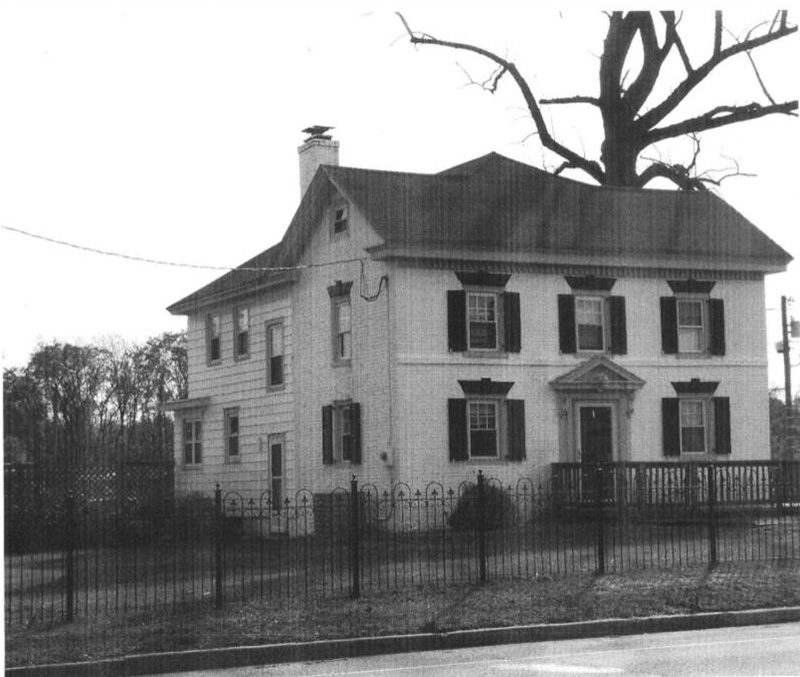
Prior to the Revolution, John Hatton, Esq., was one of the most hated men in the province of New Jersey.
The enmity between Hatton and the people probably started when the Stamp Act was passed in 1765, and Hatton was appointed Distributor of Stamps for Salem County by William Franklin, the last royal governor of New Jersey. A deputation of concerned citizens promptly gathered at Hatton’s house and coerced him into signing an agreement in which he promised not to distribute the despised stamps unless “it shall be, or appear to be, the Desire of the People.”
Fortunately for all concerned, Parliament repealed the Stamp Act.
Undaunted, Hatton became His Majesty’s Collector of Customs for the Port of Salem and Cohansey in 1767. As customs collector, Hatton was the physical embodiment of the King’s authority in the colony.
In the performance of his duty, Hatton was accused of being a “petty tyrant” by the inhabitants, who further described him as “overbearing, haughty, impudent, and a spy upon the people at large.”
Even his boss, Governor Franklin, called Hatton “a man of very unhappy, violent temper, sometimes bordering on madness.” If the governor felt that way, it was little wonder that Hatton complained that every man’s hand was against him.
An illustration of Hatton’s perhaps overzealous performance of his job occurred in November of 1770. The merchant ship, Prince of Wales. was busy offloading illicit cargo onto waiting pilot boats in Delaware Bay when Hatton received word of this illegal activity.
Hatton, his son, and Ned, an enslaved manservant, rowed out to the ship and attempted to seize one of the pilot boats. A scuffle ensued. Consequently, the Hattons and their servant were beaten and robbed by the smugglers.
Instead of receiving assistance from the local magistrates at Cape May, Hatton was charged with assault and attempted theft of one of the pilot boats. He was imprisoned along with Ned until Hatton could post bond for their release.
Hatton next sent a letter by way of his son, who was the least wounded in the fracas in the bay, to the collector of customs at the Port of Philadelphia, warning him to be on the lookout for the Prince of Wales and the pilot boats. John Hatton, Jr., was subsequently spotted nosing around the waterfront by a group of sailors.
The jacktars recognized the young man and beat him severely. The ruffians then proceeded to strip, tar and feather the boy and parade him through the streets before locking him in the pillory. After that, Hatton was rowed out to the middle of the Delaware and ducked repeatedly until he nearly drowned. Finally tiring of the sport, young Hatton’s assailants dumped him off on the New Jersey side of the river.
Meanwhile back in Cape May County where the Hatton’s owned a plantation, Hatton Sr. was repeatedly threatened by his neighbors and had to resort to traveling by night for his own safety. One of Hatton’s neighbors, Jedidiah Mills, accosted him on the public road with a club, threatening to beat the Custom Collector’s brains out.
When Hatton reached into his coat for his pocket pistol, Mills ran away. Fearing for his life, Hatton decided that the situation had gotten too heated in Cape May. Therefore, Hatton moved his family to Swedesboro, where Hatton owned another house and property on the Kings Highway.
After the Declaration of Independence was signed in 1776, the Pennsylvania Committee of Safety ordered the arrest of John Hatton, Sr. for harboring a fugitive in his home at Swedesboro. Colonel Moses Kirkland, a notorious Tory, had escaped from a Philadelphia prison and was reported to be staying at Hatton’s house.
But when the authorities came to arrest Hatton and his guest, Kirkland had already fled along with Hatton’s son to join the British Army. Hatton, Sr., was promptly apprehended and taken to Philadelphia where he was incarcerated.
Hatton was permitted to pay his bail and returned home. Threatened once again with imprisonment in 1777, Hatton fled to the British when General Howe and his army occupied Philadelphia.
Hatton’s long-suffering wife remained at home in Swedesboro but was repeatedly harassed by her neighbors. The Reverend Nicholas Collin wrote that Mrs. Hatton had been “robbed in the most dishonorable manner, of cattle, household goods, clothing, etc.” In July 1778, Mrs. Hatton had had enough.
According to Collin, she was given permission to cross over the lines of the opposing forces to rejoin her husband now with the British in New York City, provided that the man who drove her there “give assurance that he would bring back the bed on which she was lying and without which she could not travel, being weak by sorrow and illness.”
John Hatton’s properties in Swedesboro and in Cold Spring, Cape May County, were eventually confiscated by the new Patriot government. Having lost everything in America, the Hattons sailed for England at the conclusion of the war. Hatton last appears in the historical record in 1788. He was living off of a government pension in London.
By Bennett Carlton, Swedesboro Woolwich Historical Society